Ash Vacuum vs Shop Vac: Which Should You Use for Grill Ash? (November 2026)
Choose an ash vacuum for cooled grill ash because its filter and metal canister are built around fine ash containment. Use a shop vac when you also need wet pickup, blowing, and larger general cleanup.
On this page (9 sections)
- Ash vacuum vs shop vac: which is safer for cooled grill ash?
- Which vacuum contains grill ash better?
- Who should choose the PowerSmith PAVC101?
- Does the PowerSmith deep cleaning kit help with grill ash?
- When is a shop vac the better choice?
- How should you clean cooled grill ash?
- What should you do with the collected ash?
- Can a vacuum help clean a kamado grill?
- Final choice: ash vacuum or shop vac?
Choose an ash vacuum for cooled grill ash because its filter and metal canister are built around fine ash containment. A shop vac makes more sense when you also need wet pickup, blowing, and general garage cleanup.
The ash vacuum vs shop vac choice is mainly about filtration, ash containment, and how often you clean your grill.
A dedicated ash vacuum is built for one job and does that job in a more focused way.
It uses a filter system and collection path selected for fine ash rather than for mixed wet and dry debris.
That focus matters every time you lift a grill lid and find a thin layer of dust settled across the fire area.
Ash does not behave like sawdust or floor dirt because it is light, dry, and easy to stir up.
A vacuum that lets that dust drift back into the air has not finished the cleanup, even if the visible ash is gone.
A shop vac gives you a wider range of jobs in a single machine.
It can handle dry debris, liquids, and blowing tasks that come up around a garage, workshop, or job site.
That range is useful when grill ash is an occasional job rather than the main reason you need a vacuum.
The trade-off is that a general-purpose design does not prove ash-focused containment on its own.
Filter type, collection setup, and emptying method all shape how well fine ash stays inside the tank.
For cooled grill ash, those details deserve more weight than tank size or motor rating.
A larger tank can hold more material, but it cannot correct a filter or collection setup that is not suited to ash.
Frequency matters too because repeated cleanup wears a filter and hose faster than an occasional job.
If you clean your grill after every few cooks, a focused ash setup is easier to keep in good condition.
If you clean less often and need one vacuum for many tasks, a shop vac may earn its space.
This comparison covers cooled grill ash only.
Never vacuum glowing embers, smoking ash, or material that may still be hot.
Wait until the grill and ash are fully cool, with no glow, smoke, or warmth left under the surface.
That safety rule comes before any choice about hose, filter, or tank.
Once the ash is fully cool, choose the vacuum that matches the material and the rest of your cleanup routine.
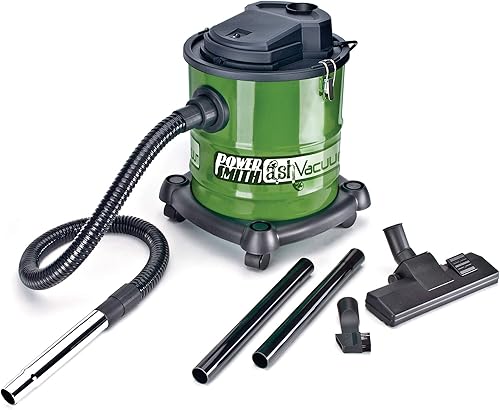 Best for regular grill ash cleanup
PowerSmith PAVC101 10 Amp Ash Vacuum
 Best for tight grill spaces
PowerSmith PAAC302 Ash Vacuum Deep Cleaning Kit
Ash vacuum vs shop vac: which is safer for cooled grill ash?
An ash vacuum is the better fit for cooled grill ash because it is designed around ash collection. The PowerSmith PAVC101 has a washable and replaceable fire-resistant filter system, plus a heat-resistant metal hose and metal canister.
Those parts address the main cleanup problem: fine ash can escape through a poorly matched filter or spread when you empty a container. The PAVC101's 2-stage filter system is described as capturing fine ash, while its metal-lined hose and canister are intended for fireplace, wood stove, pellet stove, and barbeque grill cleanup.
A shop vac is not automatically unsafe for cooled ash, but its broad wet/dry design does not by itself confirm ash-focused containment. The DEWALT 9 Gallon Wet/Dry VAC and STANLEY 10 Gallon Wet Dry Vacuum both use cartridge filters and include disposable dust bags, but you still need to follow the exact filter and bag instructions for dry ash.
Treat the temperature question separately from the vacuum choice. A metal canister or fire-resistant filter does not give you permission to collect hot coals or glowing debris.
Ash vacuum vs shop vac filtration
The ash vacuum has the clearer filtration advantage for fine grill ash. Its filter system is washable, replaceable and fire-resistant, while the shop vac models here are built around cartridge filtration for wet and dry pickup.
A cartridge filter can be useful for dry debris, but ash is unusually fine and easy to disturb during emptying. Keep the filter in good condition, inspect it after cleanup, and replace it when the manufacturer says it is due or when it no longer seals properly.
For more replacement guidance, see our best ash vacuum filter guide. A clean filter helps maintain airflow, but it cannot correct a collection setup that is not meant for ash.
Which vacuum contains grill ash better?
The dedicated ash vacuum gives you the more focused containment setup. The PowerSmith PAVC101 combines a 3-gallon ash capacity with a metal canister, a metal hose, and a filter system made for fine ash.
Its 16-foot cord and wheeled base also help when the grill is not directly beside an outlet. The included metal nozzle, brush nozzle, turbo nozzle, 2 straight extension wands, and wheeled base cover several cleanup positions.
The canister size and ash capacity are different measurements here. The product has a 5.2-gallon canister size and a 3-gallon ash capacity, so don't treat the larger figure as the amount of ash you should load.
A shop vac usually gives you a larger general-purpose tank. The DEWALT has a 9-gallon tank, while the STANLEY has a 10-gallon polypropylene tank.
That extra room helps with large cleanup jobs, but capacity alone does not make a vacuum better at containing fine ash.
Use a closed, careful emptying routine. Turn the vacuum off, move it outdoors if practical, avoid shaking the container, and follow the manual for filter and dust bag removal.
Our guide to best ash vacuum cleaner compares dedicated models for readers who want a purpose-built ash cleanup tool.
Who should choose the PowerSmith PAVC101?
Choose the PowerSmith PAVC101 for regular cooled ash cleanup from a grill, fireplace, wood stove, or pellet stove. Its 10 Amp motor, 3-gallon ash capacity, heat-resistant metal hose, and metal canister match the needs of repeated ash removal.
The washable and replaceable 2-stage filter system helps make filter care part of the routine. You can remove and clean the filter as directed, then replace it when it no longer performs as intended.
This model also works as a regular shop vacuum with its additional accessories, casters, and 16-foot cord. That gives it more range than a single-purpose ash container, although it remains most useful when fine ash cleanup is the main reason you are buying it.
The included accessories are useful around a grill. The metal nozzle reaches the fire area, the brush nozzle helps with loose residue, and the extension wands reduce the need to bend close to the grill.
Does the PowerSmith deep cleaning kit help with grill ash?
The PowerSmith PAAC302 helps when ash settles in tight spaces, troughs, seams, and pockets. It is an accessory kit for the PowerSmith PAVC101 and PAVC102, not a complete vacuum on its own.
The kit includes a crevice tool, brush nozzle, pellet stove hose, adapter, and storage bag. Its 1 1/4-inch attachment fit helps you use the smaller tools where a standard nozzle cannot reach.
A narrow crevice tool can help around grill edges and channels, but work slowly so you don't push ash deeper into a gap. Use the brush nozzle for loose material that needs gentle agitation before collection.
This kit is especially useful for pellet stove cleaning because it includes a pellet stove hose. For grill owners, its main value is access to narrow areas rather than extra suction or extra ash capacity.
If a hose is damaged or too short for your setup, compare options in our best ash vacuum replacement hose guide.
When is a shop vac the better choice?
Choose a shop vac when grill ash is only one part of a wider cleanup routine. Wet pickup, a blower function, larger tanks, and general workshop attachments can matter more than ash-specific filtration.
The DEWALT 9 Gallon Wet/Dry VAC has a 9-gallon tank, 5 peak HP motor rating, blower port, 7-foot hose, and 10-foot power cord. It includes a cartridge filter, disposable filter bag, floor nozzle, utility nozzle, crevice nozzle, round brush, extension wands, inflator kit and adapter.
Those features suit a garage or workshop where you move between dry debris, liquids and outdoor cleanup. The blower port can also help move leaves or sawdust, but do not use blowing to scatter grill ash near people, food, open doors, or air intakes.
The STANLEY 10 Gallon Wet Dry Vacuum has a 10-gallon polypropylene tank, 6 peak HP motor rating, wet, dry and blow functions, 4 casters, and a 6-foot hose. It includes a cartridge filter, disposable dust bag, foam filter, floor nozzle, crevice nozzle, utility nozzle, garden hose adapter, and 2 extension wands.
Its larger tank and over 24 feet of stated cleaning reach can suit a workshop or job site. The built-in drain is useful for liquids, but wet pickup parts should not be treated as a substitute for an ash-specific collection setup.
How should you clean cooled grill ash?
Clean only fully cooled ash, use the correct filter setup, and remove ash slowly to limit dust. Empty loose food debris first, then work from the edges of the fire area toward the center.
Open the grill only after it has cooled completely. Check for hidden warmth under the ash, especially around charcoal pieces and areas with limited airflow.
Use the smallest suitable nozzle for the space. For stuck-on grate residue, compare smoker grate cleaners.
A crevice tool can reach corners, while a brush nozzle can loosen residue without scraping the grill surface.
Keep the hose end close to the ash. A short distance reduces the amount of dust that can drift through the grill and onto nearby surfaces.
Stop if you see smoke, glowing material, or signs of heat. Move away from the vacuum and follow your grill and vacuum safety instructions.
After cleaning, inspect the filter and collection area outdoors. Do not use compressed air indoors to blow ash from a filter or tank.
For a wider maintenance routine, our guide to bbq cleaning tools covers brushes, scrapers, gloves, and other grill-care equipment. For a dedicated edge tool, compare BBQ grill scrapers.
What should you do with the collected ash?
Store or discard collected ash in a covered, noncombustible container only after you are sure it is fully cool. A vacuum tank is for collection, not long-term ash storage.
For a larger lidded option, compare large ash buckets with lids.
A lidded ash bucket gives you a safer place to hold cooled ash before disposal. See our guide to the best ash bucket with lid when you need a separate container.
Keep ash away from dry leaves, cardboard, wood, fuel, and other materials that could catch fire. Do not scatter ash into the air or pour it onto garden soil without checking local disposal guidance and the material you burned.
The vacuum itself should be cleaned according to its manual. Keep fine residue out of indoor rooms, and store the machine where moisture cannot damage its filter or electrical parts.
Can a vacuum help clean a kamado grill?
A dedicated ash vacuum can help remove cooled ash from a kamado grill, but the ceramic cooker still needs careful handling. Keep the nozzle away from fragile surfaces and avoid scraping vents or firebox parts.
Kamado grills can hold ash below the fire area, so a narrow attachment may help reach the lower section. The What Is a Kamado Grill? guide explains the basic design if you're comparing cooker types.
Remove only the ash that the grill's manual tells you to clear. Some cookers use airflow openings that can become blocked, while others have parts that should remain in place during cleaning.
A shop vac can work for broader cleanup around the cooker, but it remains a general-purpose option. For ash inside the cooker, the ash-focused filter and metal collection path of the PowerSmith PAVC101 are the closer match.
Final choice: ash vacuum or shop vac?
Pick an ash vacuum for regular cooled grill ash, and pick a shop vac when you need one machine for wet, dry, blowing, and workshop jobs. Filtration and containment matter more than tank size when fine ash is the main material.
Choose the PowerSmith PAVC101 if your priority is dedicated ash cleanup with a metal canister, metal hose, and fire-resistant filter system.
Its 3-gallon ash capacity suits routine grill, fireplace, wood stove, and pellet stove cleaning without moving to a larger general-purpose tank.
The washable and replaceable filter system also makes filter care part of your regular routine.
Add the PAAC302 if tight spaces and seams are hard to reach.
Its crevice tool, brush nozzle, adapter, and flexible hose help you reach troughs and pockets that a standard nozzle may miss.
Keep the kit in storage when the work is limited to the open fire area.
That keeps the main vacuum setup simple and avoids adding parts you may not need for every cleanup.
Choose the DEWALT or STANLEY if grill ash is occasional and your main jobs include liquids, leaves, sawdust, or general garage debris.
Their larger tanks, wet and dry pickup, and blowing functions cover a wider set of tasks around the home.
Use their dry collection setup exactly as directed, and vacuum only fully cooled ash.
Do not treat wet pickup parts as a substitute for an ash-focused collection setup.
Empty the tank carefully outdoors when practical and check the filter after cleanup so fine residue does not spread indoors.
For the ash vacuum vs shop vac decision, match the tool to the material first, then consider capacity, hose reach, storage, and the other cleanup jobs you expect it to handle.
Frequently asked questions
Is an ash vacuum better than a shop vac for grill ash?
An ash vacuum is usually the better choice for cooled grill ash because it uses an ash-focused filter system and a metal canister. A shop vac is more flexible for wet debris, liquids and blowing, but its general-purpose design does not make it the first choice for fine ash containment.
Can you use a shop vac to clean grill ash?
You can use a shop vac only for fully cooled ash and only with the filter and collection setup approved for that vacuum. Empty the tank carefully, keep ash away from damp pickup parts, and never vacuum hot embers or ash that may still contain heat.
How cool should grill ash be before vacuuming?
Wait until the grill and ash are fully cool, with no glow, smoke or warmth. A vacuum's motor, hose and filter do not make warm embers safe to collect unless the specific vacuum is designed and labeled for that use.
Does a shop vac filter ash dust?
A shop vac can collect dry dust through its cartridge filter, but filter type alone does not prove that it contains fine grill ash as well as an ash vacuum. Check the exact filter instructions, use a closed collection method when supported, and clean the vacuum outside.


